Key facts
- Oil output passed 900,000 barrels a day in May 2026, a national record; Vaca Muerta supplies about 70%.
- Argentina's fuel trade surplus was US$6.6 billion in January–August 2026, up 72.5% on a year earlier (INDEC).
- Lithium output rose 62% in 2025 to about 120,000 tonnes of lithium carbonate equivalent, from seven projects.
- Argentina has the world's largest identified lithium resources (USGS).
- The VMOS export pipeline, over 70% complete in July 2026, is due to ship first cargoes around the turn of 2027.
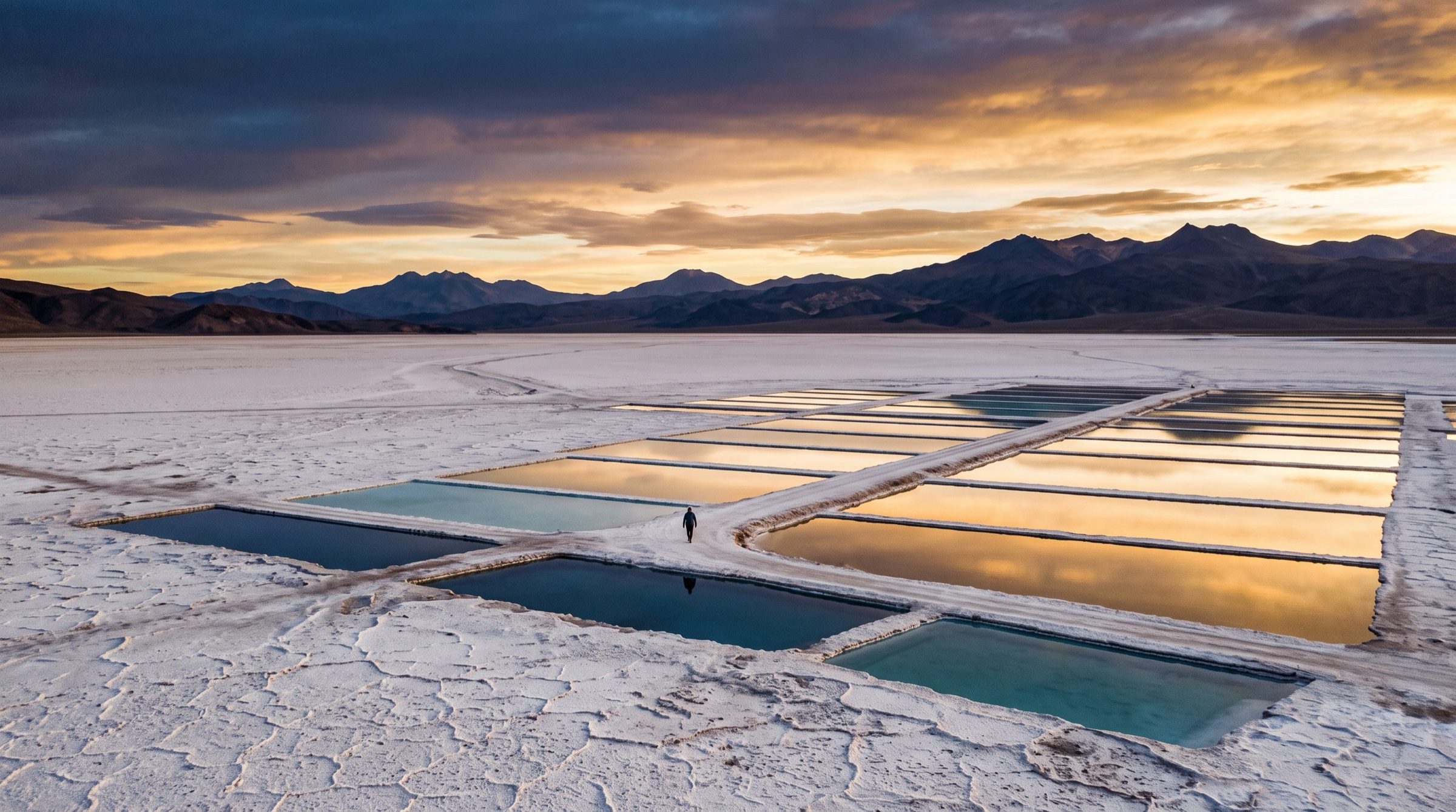
For decades, Argentina imported energy. Today it exports it. The change comes from two places: Vaca Muerta, a shale formation in Patagonia, and the high-altitude salt flats of the northwest, part of the “lithium triangle” shared with Chile and Bolivia.
This briefing sets out the official and industry data as of 10 October 2026, how private investors usually gain exposure, and the main risks. It is general information, not investment advice. We do not recommend any security. Speak to a qualified, regulated adviser before you invest.
Vaca Muerta: from discovery to record output
Vaca Muerta lies in the Neuquén basin, mainly in Neuquén province, with parts in Mendoza, Río Negro and La Pampa. In 2013 the US Energy Information Administration (EIA) estimated about 16.2 billion barrels of technically recoverable oil. In 2017 it estimated 308 trillion cubic feet of shale gas. A new study by the Argentine Oil and Gas Institute (IAPG), made for the Secretaría de Energía and published in August 2026, almost doubled the oil estimate to about 30.2 billion barrels.
Production records
| Month | National oil output (barrels a day) | Note |
|---|---|---|
| October 2025 | 859,500 | First month above the 1998 record |
| May 2026 | 903,700 | First month above 900,000 (Secretaría de Energía) |
| July 2026 | 916,200 | Up 17.2% year on year; Vaca Muerta 643,100 |
Vaca Muerta supplied 69% of national crude in May 2026 and more than 70% in July. Gas is growing more slowly: in July 2026 the formation produced 96.5 million cubic metres a day, out of a national total of 158.8 million.
The trade effect
INDEC data shows that Argentina’s trade surplus in mineral fuels (chapter 27 of the tariff code) was US$6.58 billion in January–August 2026, against US$3.81 billion a year earlier. Crude oil exports rose 54.7% to US$6.63 billion. Some forecasters expect an energy surplus above US$12 billion for 2026. For the wider economic picture, see Argentina’s economy under Milei.
The bottleneck: getting oil and gas out
Output is now limited by infrastructure as much as by geology:
- Oil pipelines. The Oldelval system carries 530,000 barrels a day. A US$25 million upgrade aims to add up to 200,000 barrels a day of interruptible capacity as a bridge, according to NoticiasNQN.
- VMOS. The Vaca Muerta Oil Sur pipeline, owned by a consortium of YPF, Vista, Pan American Energy, Pampa, Chevron, Pluspetrol, Shell and Tecpetrol, runs to a new export terminal at Punta Colorada in Río Negro. It cost about US$3 billion and was more than 70% complete in July 2026. It should start at 180,000 barrels a day, with first export cargoes planned for late 2026 or early 2027, and grow from there.
- LNG. Southern Energy, owned by Pan American Energy, YPF, Pampa, Harbour Energy and Golar LNG, took its final investment decision in May 2025. Two floating units will produce about 6 million tonnes a year, from around the end of 2027 and 2028. A larger project, Argentina LNG (YPF, Eni and XRG), plans 12 million tonnes a year and has applied for the RIGI. Its final investment decision is targeted for the end of 2026.
Several of these projects use the RIGI, the large-investment regime. See the RIGI explained.
Lithium: the northwest’s new industry
Argentina’s lithium comes mainly from brine under the high-altitude salt flats (salares) of Catamarca, Salta and Jujuy.
The numbers
The US Geological Survey’s Mineral Commodity Summaries 2026 reports:
| Measure | Argentina | Context |
|---|---|---|
| Mine production 2024 | 13,800 tonnes of lithium content | — |
| Mine production 2025 | 23,000 tonnes | Fifth, after Australia, China, Chile and Zimbabwe |
| Reserves | 4.4 million tonnes | Chile 9.2m, Australia 8.4m |
| Identified resources | 28 million tonnes | The largest in the world |
The Secretaría de Minería put 2025 output at about 120,000 tonnes of lithium carbonate equivalent (LCE), up 62%, from seven operating projects. Its October 2026 report projects that Argentina will overtake Chile as the world’s third-largest producer in 2029.
Main operations
| Province | Operation | Operator or owners |
|---|---|---|
| Catamarca | Fénix and Sal de Vida (Salar del Hombre Muerto) | Rio Tinto |
| Catamarca | Hombre Muerto Oeste | Galan Lithium |
| Salta | Rincón | Rio Tinto; approved under the RIGI, about US$2.5 billion |
| Salta | Centenario-Ratones | Eramet |
| Salta | Mariana | Ganfeng |
| Jujuy | Olaroz | Rio Tinto (66.5%), Toyota Tsusho (25%), province (8.5%) |
| Jujuy | Cauchari-Olaroz | Minera Exar: Lithium Argentina (44.8%), Ganfeng, province (8.5%) |
Rio Tinto became the largest player when it completed its acquisition of Arcadium Lithium on 6 March 2025. Rincón is designed for about 60,000 tonnes a year of lithium carbonate. A small starter plant has already shipped a first cargo, and production from the main plant is expected in 2028, according to Panorama Minero. Cauchari-Olaroz expects 35,000 to 40,000 tonnes in 2026, according to Lithium Argentina.
Prices
Lithium prices are volatile. USGS reports that the US contract price for lithium carbonate averaged US$9,000 a tonne in 2025, down 31% on 2024. Prices recovered in 2026. Chinese lithium carbonate traded at about CNY 122,000 a tonne on 9 October 2026, up about 66% on a year earlier but down about 15% in a month, according to Trading Economics.
How private investors gain exposure
There are three common routes. We list them for information only; we do not recommend any of them.
1. Argentine companies listed in New York. Several energy companies with Vaca Muerta operations have American depositary receipts on the New York Stock Exchange, including YPF (YPF), Vista Energy (VIST), Pampa Energía (PAM) and the gas transporter TGS (TGS). They also trade in Buenos Aires.
2. Global miners and lithium producers. Exposure to Argentine lithium usually comes bundled with other assets. Examples include Rio Tinto (NYSE: RIO), Lithium Argentina (NYSE and TSX: LAR), POSCO Holdings (NYSE: PKX), Eramet (listed in Paris), Ganfeng (listed in Hong Kong and Shenzhen) and smaller Australian-listed developers.
3. Funds. The Global X MSCI Argentina ETF (ARGT) holds Argentine equities. On 8 October 2026 its largest holding was MercadoLibre at 22.8%, ahead of YPF (10.1%) and Vista (7.0%), so it is not a pure energy fund. Global lithium funds hold miners and battery makers worldwide, with limited Argentine content.
Private placements in individual projects exist, but usually need very large tickets and specialist due diligence. If you live in Argentina, your holdings may also fall within the personal assets tax.
The risks
- Commodity prices. Shale economics depend on oil prices; lithium fell sharply in 2023–2025 before its 2026 recovery.
- Infrastructure. Until VMOS and new gas pipelines are running, transport capacity limits growth.
- Politics. The October 2027 presidential election will test the durability of the current reforms, including the RIGI’s 30-year promises.
- Provinces and communities. Under Article 124 of the Constitution, natural resources belong to the provinces, which grant permits and collect royalties. In Jujuy in 2023, a constitutional reform led to mass protests; Amnesty International documented excessive police force and concerns from Indigenous communities about water rules and resource exploitation.
- Currency and access to capital. Argentina’s history of currency controls is recent, and some rules remain. See our banking guide.
- Project delays. Large projects such as Argentina LNG had not yet reached a final investment decision in October 2026.
The citizenship angle
Investing in Argentine energy or mining does not, by itself, lead to citizenship. The Argentina citizenship by investment programme announced on 2 October 2026 has two routes: a US$350,000 contribution or a US$800,000 bond. See the cost guide. Its legal basis, DNU 366/2025, was declared unconstitutional by the Cámara Nacional Electoral in June 2026, and the government’s appeal is now with the Supreme Court. See legal status.
Sources
- Ámbito, May 2026 oil record, Secretaría de Energía data (1 July 2026): https://www.ambito.com/energia/nuevo-record-produccion-petroleo-gracias-vaca-muerta-la-argentina-supero-primera-vez-los-900000-barriles-diarios-n6294765
- El Economista, July 2026 oil and gas output (28 August 2026): https://eleconomista.com.ar/energia/argentina-produccion-petroleo-alcanzo-916200-barriles-diarios-julio-crecio-172-ano-n97767
- Buenos Aires Herald, October 2025 record (26 December 2025): https://buenosairesherald.com/business/energy/argentina-ends-record-year-in-oil-production-and-energy-surplus-thanks-to-vaca-muerta
- INDEC, Intercambio comercial argentino, August 2026 (September 2026): https://www.indec.gob.ar/uploads/informesdeprensa/ica_09_266E5973E036.pdf
- US EIA, shale gas resources in Argentina (10 February 2017): https://www.eia.gov/todayinenergy/detail.php?id=29912
- Infobae, IAPG estimate of Vaca Muerta oil (13 August 2026): https://www.infobae.com/economia/2026/08/13/a-13-anos-del-primer-pozo-vaca-muerta-tiene-casi-el-doble-de-petroleo-del-que-se-calculo-originalmente/
- NoticiasNQN, VMOS progress (28 July 2026): https://www.noticiasnqn.com.ar/noticias/2026/07/28/345390-el-megaproyecto-que-cambiara-vaca-muerta-el-oleoducto-vmos-ya-supera-el-70por_ciento-de-ejecucion
- NoticiasNQN, Oldelval capacity (24 July 2026): https://www.noticiasnqn.com.ar/noticias/2026/07/24/344839-oldelval-ampliara-la-capacidad-de-transporte-de-petroleo-para-acompanar-el-crecimiento-de-vaca-muerta
- Harbour Energy, Southern Energy final investment decision (2 May 2025): https://www.harbourenergy.com/news-and-media/southern-energy-sa-final-investment-decision/
- OilPrice.com, Argentina LNG applies for the RIGI (16 August 2026): https://oilprice.com/Company-News/Argentina-LNG-Seeks-RIGI-Approval-for-51-Billion-Export-Project.amp.html
- USGS, Mineral Commodity Summaries 2026, Lithium: https://pubs.usgs.gov/periodicals/mcs2026/mcs2026-lithium.pdf
- LMNeuquén, Secretaría de Minería lithium report (5 October 2026): https://mase.lmneuquen.com/mineria/litio-argentina-proyecta-superar-chile-como-tercer-productor-mundial-2029-n1256178
- Rio Tinto, completion of the Arcadium Lithium acquisition (6 March 2025): https://www.riotinto.com/en/news/releases/2025/rio-tinto-completes-acquisition-of-arcadium-lithium
- Panorama Minero, Rincón financing and Rio Tinto’s Argentine operations (10 March 2026): https://www.panorama-minero.com/en/news/rio-tinto-secures-us-1-175-billion-for-argentina-lithium-project-as-rincon-begins-exports
- Lithium Argentina, MD&A (SEC filing, May 2026): https://www.sec.gov/Archives/edgar/data/0001440972/000119312526218128/lar-ex99_2.htm
- Trading Economics, lithium carbonate price (9 October 2026): https://tradingeconomics.com/commodity/lithium
- Global X, MSCI Argentina ETF (ARGT) holdings (8 October 2026): https://www.globalxetfs.com/funds/argt/
- InfoLEG, Constitución de la Nación Argentina (Art. 124): https://servicios.infoleg.gob.ar/infolegInternet/anexos/0-4999/804/norma.htm
- Amnesty International, Jujuy protests (5 October 2023): https://www.amnesty.org/en/latest/news/2023/10/argentina-repression-criminalization-protests-jujuy/
- argentina.gob.ar, citizenship by investment announcement (2 October 2026): https://www.argentina.gob.ar/noticias/luis-caputo-anuncio-la-puesta-en-marcha-del-programa-de-ciudadania-por-inversion-de