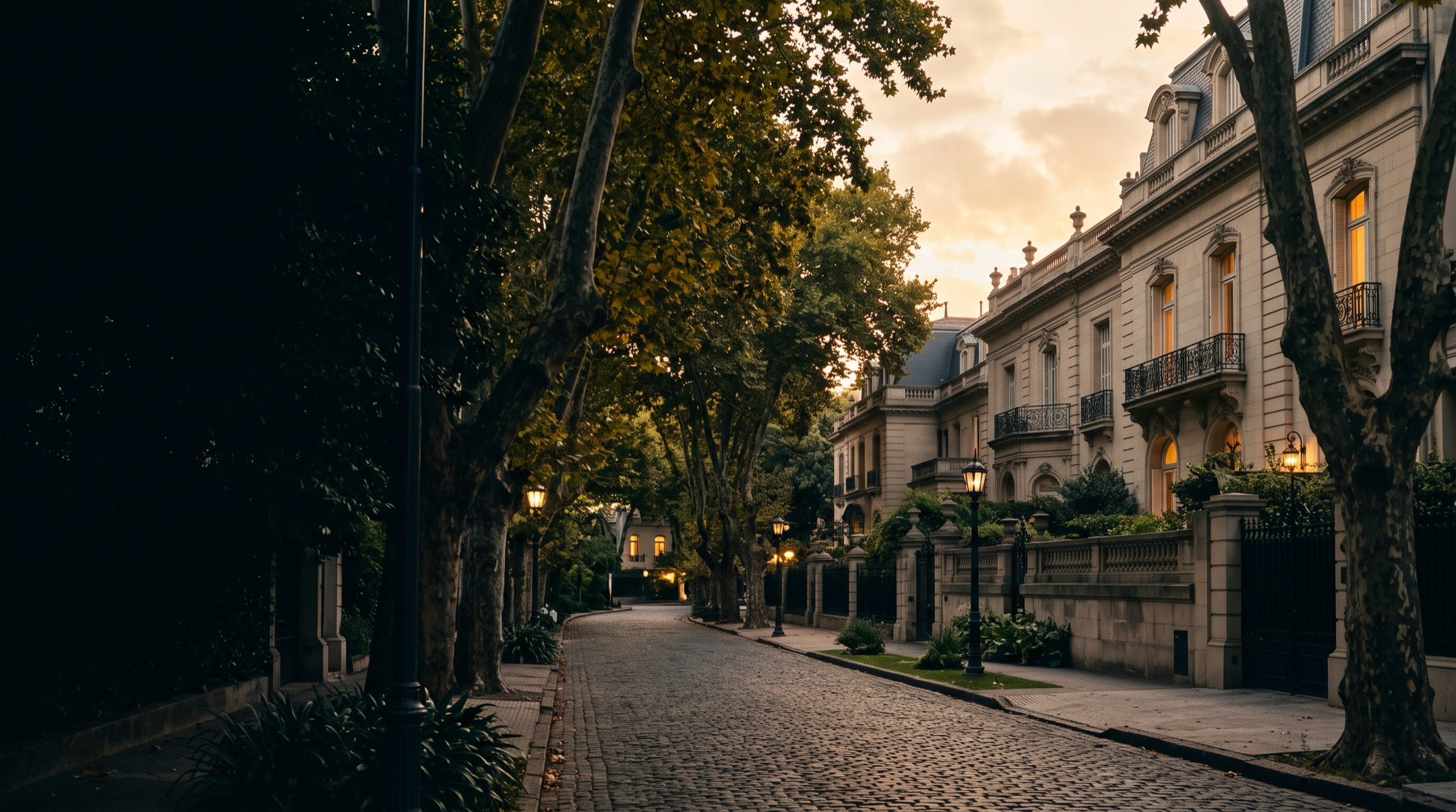
Key facts
- City average asking price: about US$2,471 per m² (Zonaprop, July 2026).
- Puerto Madero is the most expensive barrio, at about US$6,122 per m².
- Average city rent for a three-room flat: about ARS 1.18 million a month in July 2026.
- Many leading bilingual schools sit in the northern suburbs, from Belgrano to Nordelta.
- Rents rose about 31% in pesos in the 12 months to July 2026.
Buenos Aires is less one city than a collection of villages, each with its own pace. Most newcomer families choose between two models. The first is city life in Recoleta, Palermo, Puerto Madero or Belgrano, with restaurants, galleries and parks within walking distance. The second is suburban life in the northern corridor, from Vicente López to San Isidro and Nordelta, where gardens, clubs and many top schools are close.
This guide compares six areas. Prices come from the Zonaprop index for July 2026 and the UADE–Argenprop report for June 2026. Property prices in Argentina are quoted in US dollars; rents in the city are mostly in pesos. Use them as a guide, not as a valuation.
The six areas at a glance
| Area | Character | Asking price, US$/m² (2026) | Schools nearby |
|---|---|---|---|
| Recoleta | Classic, Parisian architecture, central | ~2,700 used; ~3,850 new (UADE, June) | City schools; short drive to Belgrano |
| Palermo Chico / Barrio Parque | Embassies, mansions, quiet streets | Palermo average ~3,430 (Zonaprop, July); prime streets far higher | Belgrano and northern schools |
| Puerto Madero | Modern towers on the old docks | ~6,120 (Zonaprop, July) | Commute to Belgrano or the north |
| Belgrano (incl. Belgrano R) | Leafy, residential, family-oriented | ~2,630 (Zonaprop); ~3,060 used (UADE) | Belgrano Day School, Washington School, St Brendan’s |
| San Isidro | Riverside town, clubs, old houses | ~2,780 (district average, Zonaprop GBA) | Cardenal Newman, Goethe-Schule; Olivos schools close |
| Nordelta (Tigre) | Planned lakeside town of gated barrios | Tigre district ~2,760 (Zonaprop GBA) | Northlands, Michael Ham, others |
The two indices use different methods and data, so their figures differ. Compare areas within one source, not across sources.
Recoleta: the classic choice
Recoleta is the Buenos Aires of postcards: French-style apartment buildings, wide avenues and good cafés. Its centre is the Recoleta Cemetery, opened in 1822 on a former convent garden, where Eva Perón is buried. Museums, the Teatro Colón and the main business district are all a short taxi ride away.
Housing is mostly apartments, from grand pre-war flats with high ceilings to modern buildings. In June 2026 used apartments were offered at about US$2,700 per m² and new ones at about US$3,850 (UADE–Argenprop). The best addresses sell well above that.
Recoleta suits couples, older children and families who want a walkable life. Parking and private outdoor space are limited.
Palermo Chico and Barrio Parque: quiet prestige
Between Avenida del Libertador and the parks of Palermo lies a small district of curved streets drawn up by the park designer Carlos Thays in 1912. Palermo Chico, and its inner part known as Barrio Parque, hold many embassies and ambassadors’ residences, as well as the Palacio Errázuriz and the MALBA museum.
This is one of the few parts of the city with large single-family houses and gardens. Supply is very small, and many homes change hands privately. The Palermo average of about US$3,430 per m² (Zonaprop, July 2026) covers the whole large barrio and understates prices here.
The rest of Palermo is younger and busier, with restaurants, design shops and the Palermo parks. The polo ground at Palermo, home of the Argentine Open, is close by.
Puerto Madero: modern and secure
Puerto Madero is the city’s newest barrio, built on the old port docks after a development corporation was created in 1989. It has four docks lined with converted brick warehouses and glass towers, the Puente de la Mujer footbridge by Santiago Calatrava, and the Costanera Sur ecological reserve next door.
It is the most expensive barrio in Buenos Aires. Zonaprop’s July 2026 index puts the average at about US$6,122 per m², roughly two and a half times the city average. It is also the most expensive barrio to rent, at about ARS 1.31 million a month for a two-room flat.
Buyers choose Puerto Madero for security, river views, modern buildings with services and quick access to the business district. Critics find it quiet at night and far from most schools.
Belgrano and the River Plate side: space for families
Belgrano, north of Palermo, was a separate town until it joined the city in 1887. Today it has two faces. Belgrano C, around Avenida Cabildo, is commercial and busy. Belgrano R is residential, with English-style houses, trees and several leading private schools. The Barrancas de Belgrano park and the small Chinatown on Calle Arribeños are local landmarks.
Just north, Núñez is home to River Plate’s Estadio Monumental. The streets around it, which some locals call Barrio River, offer newer towers with amenities and slightly better value.
Belgrano averaged about US$2,630 per m² in Zonaprop’s July 2026 index, and Núñez about US$3,390. Average rent in Belgrano was about ARS 785,000 a month in February 2026. For many families it is the best balance between city life and space, with Belgrano Day School, Washington School and St Brendan’s College all nearby.
San Isidro: riverside town life
San Isidro, founded in 1706, sits on the Río de la Plata in the northern suburbs. It has a neo-Gothic cathedral completed in 1898, cobbled streets near the river and a strong club culture. The Jockey Club’s racecourse, about 22 km from the city centre, and rugby clubs such as CASI and SIC shape local life.
Housing ranges from historic quintas and large houses with gardens to apartments and gated communities. The district averaged about US$2,780 per m² in July 2026 (Zonaprop GBA). Nearby La Lucila, in Vicente López, is the most expensive barrio of the northern zone at about US$3,875 per m².
Schools are the main draw. Colegio Cardenal Newman and the Goethe-Schule are in Boulogne, within the San Isidro district. Lincoln, St Andrew’s Scots School and Northlands are a short drive away in La Lucila, Olivos and San Fernando.
Nordelta: the planned lakeside town
Nordelta, in the Tigre district about 30 km from the city, opened in 1999 as Argentina’s first planned “town-village”. It was built on former wetland shaped into lakes, and is organised as a series of gated barrios with their own security, a commercial centre, clinics and schools. Northlands and Michael Ham both have campuses there.
Rents in mid-2026 started at about US$500–600 a month for small apartments and reached more than US$17,000 for the largest houses, according to iProfesional. Monthly service charges (expensas) for houses ran from about ARS 800,000 to ARS 1.2 million. Prices for the Tigre district as a whole averaged about US$2,760 per m².
Nordelta suits families with young children who want gardens, water sports and a sense of security. The cost is distance: the commute into the city can be long at peak hours.
How to choose
Ask three questions in this order:
- Which school? For school-age children, the school decides the area. See our guide to international schools in Buenos Aires.
- City or garden? Apartments dominate in the city; houses with gardens are mostly in the suburbs.
- How often will you commute? Traffic on the northern motorways can double travel times.
We suggest you rent for the first year before you buy. Our guide to buying property in Argentina as a foreigner explains the process, and our luxury cost of living guide sets out a full budget.
Living here and citizenship
Buying a home does not by itself give residence or citizenship. Families who want an Argentine passport may consider the new Argentina citizenship by investment programme, announced on 2 October 2026. Its legal basis, DNU 366/2025, was ruled against by the Cámara Nacional Electoral in June 2026, and the government has appealed to the Supreme Court; see our legal status update. For family members, the programme sets separate contributions. Speak to a qualified adviser before you decide.
Sources
- Zonaprop Index, CABA, July 2026: https://www.zonaprop.com.ar/blog/wp-content/uploads/2026/08/INDEX_CABA_REPORTE_2026-07.pdf
- Zonaprop Index, GBA, July 2026: https://www.zonaprop.com.ar/blog/wp-content/uploads/2026/08/INDEX_GBA_REPORTE_2026-07.pdf
- UADE–Argenprop, Mercado de Inmuebles report, June 2026: https://uade.edu.ar/media/mv4dmiii/junio-2026-mei.pdf
- iProfesional, renting in Recoleta in 2026 (6 Feb 2026): https://www.iprofesional.com/realestate/447136-alquilar-en-recoleta-en-2026-cuanto-piden-hoy-por-un-dos-ambientes-y-que-barrios-compiten
- iProfesional, renting in Nordelta (9 Jun 2026): https://www.iprofesional.com/realestate/456306-cuanto-cuesta-alquilar-una-casa-o-departamento-en-los-barrios-mas-baratos-de-nordelta
- La Recoleta Cemetery: https://en.wikipedia.org/wiki/La_Recoleta_Cemetery
- Palermo Chico: https://es.wikipedia.org/wiki/Palermo_Chico
- Puerto Madero: https://es.wikipedia.org/wiki/Puerto_Madero
- Belgrano: https://es.wikipedia.org/wiki/Belgrano_(Buenos_Aires)
- Barrio Chino de Buenos Aires: https://es.wikipedia.org/wiki/Barrio_Chino_(Buenos_Aires)
- San Isidro: https://es.wikipedia.org/wiki/San_Isidro_(Buenos_Aires)
- Hipódromo de San Isidro: https://en.wikipedia.org/wiki/Hipódromo_de_San_Isidro
- Club Atlético San Isidro: https://es.wikipedia.org/wiki/Club_Atlético_San_Isidro
- Nordelta: https://en.wikipedia.org/wiki/Nordelta
- Estadio Monumental: https://en.wikipedia.org/wiki/Estadio_Monumental_(Buenos_Aires)