Key facts
- Córdoba's Capital department had 1,505,250 residents in the 2022 census; Greater Córdoba about 1.7 million.
- The Universidad Nacional de Córdoba dates from 1613, one of the oldest universities in the Americas.
- The Jesuit Block and Estancias of Córdoba became a UNESCO World Heritage Site in 2000.
- Córdoba airport lies 9 km from the centre, with direct flights to Panama City and, since June 2026, Miami.
- La Cumbrecita, at about 1,450 metres, is Argentina's only fully pedestrian village.
For many foreign families, Argentina means Buenos Aires, Mendoza or Patagonia. Córdoba is the overlooked option. It is a large, working city with universities, private clinics and a direct air link to the United States, and it sits at the foot of a range of low mountains where Argentines have taken their holidays for a century.
This guide looks at the city, the two Sierra valleys most popular with second-home buyers, and the practical points to check before you commit.
Córdoba city: churches, students and industry
Córdoba is Argentina’s second-largest city. The final 2022 census counted 1,505,250 residents in the Capital department and 1,705,741 in Greater Córdoba, out of a provincial population of 3.84 million.
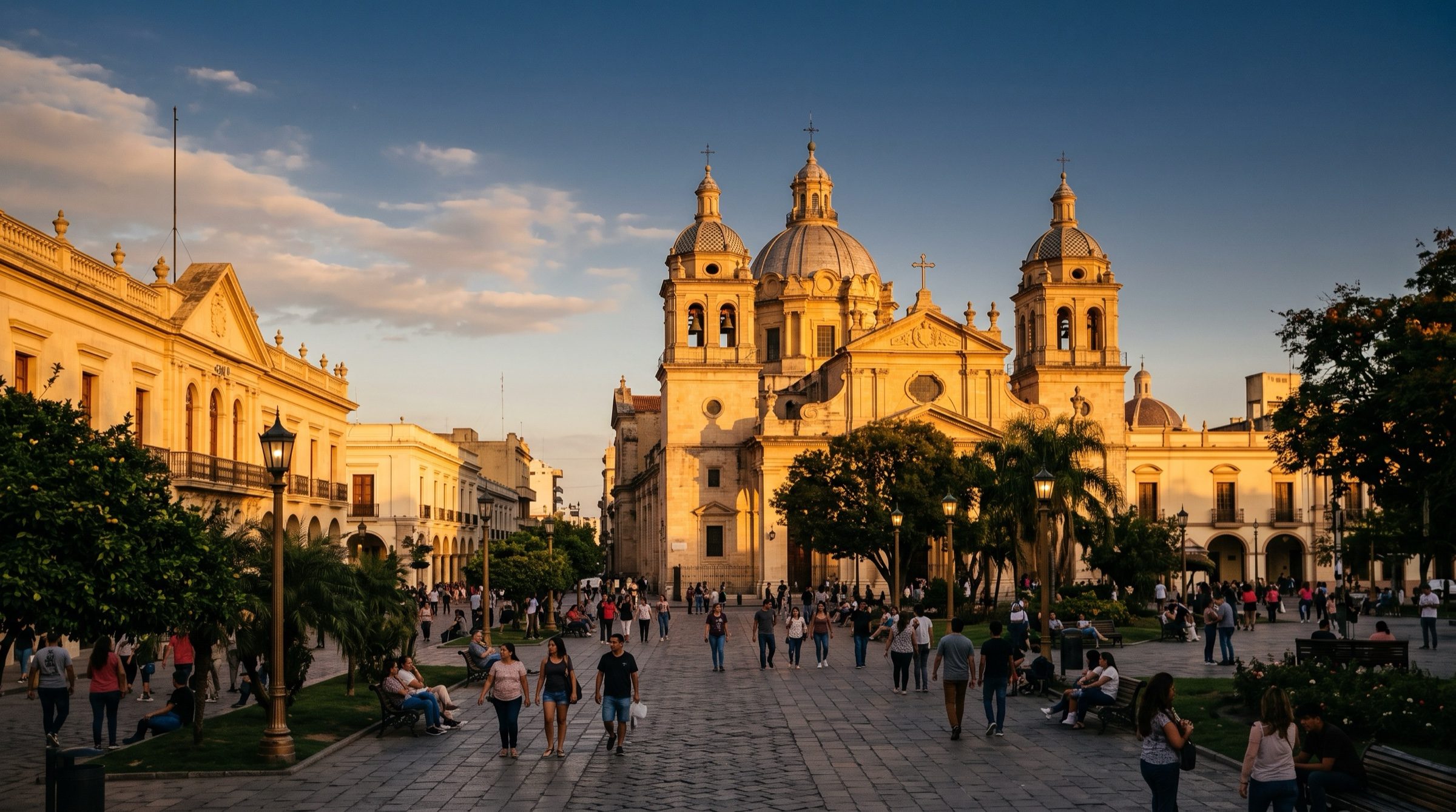
The historic centre grew around the Jesuit order. The Jesuit Block (Manzana Jesuítica) holds the church, the former residence of the Jesuit fathers, the original university buildings and the Colegio Nacional de Monserrat. UNESCO listed it in 2000 together with five rural Jesuit estates: Alta Gracia, Santa Catalina, Jesús María, La Candelaria and Caroya. Several of these estancias are an easy day trip from the city.
The Universidad Nacional de Córdoba dates its foundation to 1613. Its roots lie in an older Jesuit college, and it gained the right to grant degrees in the 1620s. The university gives the city a young population and a strong cultural calendar, and it is one reason Córdoba is called La Docta, “the learned”.
For a family, the city offers private hospitals, private schools and a full range of services. Ask schools directly about places and curricula. Our guide to international schools in Buenos Aires explains what to look for.
Getting there and away
Ingeniero Aeronáutico Ambrosio Taravella International Airport (COR) lies about 9 km north-north-west of the centre. Domestic flights link Córdoba with Buenos Aires, Bariloche and other cities.
International connections have grown since 2025:
| Route | Airline | Notes |
|---|---|---|
| Córdoba–Panama City | Copa Airlines | Several daily frequencies; up to five on some days in Copa’s 2027 schedule |
| Córdoba–Miami | Aerolíneas Argentinas | Twice weekly (Fridays and Sundays) from 5 June 2026, announced as a regular route |
| Córdoba–Bogotá | Avianca | Direct service launched in 2025 |
| Córdoba–Brazil | Several carriers | São Paulo, Rio de Janeiro and seasonal beach routes |
Panama City gives one-stop access to much of North America and the Caribbean. Schedules change by season, so confirm with each airline before you plan around a route. For families who fly privately, see our guide to private aviation in Argentina.
The Calamuchita valley: Villa General Belgrano and La Cumbrecita
South-west of the city, the Calamuchita valley is the best-known part of the Sierras for buyers from abroad.
Villa General Belgrano sits at about 709 metres. Two German land speculators founded it in 1930, and settlers from Germany, Switzerland, Italy and Austria followed. In 1940 about 130 crew members of the scuttled German cruiser Admiral Graf Spee settled here, which helps explain the red roofs and timber-framed houses. Its Fiesta Nacional de la Cerveza, an Oktoberfest, reached its 63rd edition in 2026, over two long weekends in October.
La Cumbrecita, about 40 km to the west, lies at about 1,450 metres in a small valley of the Sierras Grandes. The Cabjolsky family bought 500 hectares here in 1934, and the village grew from that purchase. Since 1996 it has been a pedestrian village: visitors leave their cars at the entrance and walk in. It is tiny, with fewer than 200 residents at the 2001 census, and very busy on long weekends.
The valley suits families who want a summer retreat in the hills, forest walks and a village with restaurants and services.
Traslasierra: the quieter side
West of the Sierras Grandes, Traslasierra is reached from the city by the Camino de las Altas Cumbres, a paved mountain road. It has more than twenty small towns, often grouped in pairs: Mina Clavero and Villa Dolores, Nono and Villa Cura Brochero, San Javier and Yacanto.
- Mina Clavero is known for its river pools, waterfall and sandy river beaches, and is the main service town of the valley.
- Nono is a small village with the Rocsen Museum, which holds more than 18,000 pieces.
- Villa Cura Brochero is linked to the 19th-century priest José Gabriel Brochero, the “Cura Gaucho”.
- San Javier and Yacanto are smaller villages in the south of the valley, with walking routes into the hills.
Nearby protected areas include the Quebrada del Condorito National Park and the Pampa de Achala water reserve. Local tourism officials have noted that many younger Argentines have moved to the valley to live, not only to visit. For a family, Traslasierra offers space, rivers and a slower pace; the trade-off is a longer drive to the city and the airport.
Buying in Córdoba province
Foreigners can buy urban property in Córdoba on the same broad terms as elsewhere in Argentina. You need a tax identification number, a public notary (escribano) and proof of the origin of funds. Our guide to buying property in Argentina as a foreigner explains each step.
A few points are specific to the Sierras:
- Rural plots. A house on several hectares may count as rural land. The national limits on foreign ownership of rural land are not in force after a Supreme Court ruling of 29 September 2026, but Congress could still act. Read our guide to buying an estancia.
- Water and access. Check the water source, the road in winter and summer storms, and power supply before you buy.
- Fire and insurance. Ask about the fire history of the area and whether the house can be insured against fire.
Córdoba does not border another country, so the border security zone rules that matter in the Andes do not usually apply here.
We could not find a reliable 2025–2026 source for property prices in the Sierras. Ask several local agents and compare.
Córdoba and citizenship
A home in Córdoba does not give residence or citizenship. Families who live here can use a residence permit and, after two years of legal residence, apply for ordinary naturalisation; see residency vs citizenship. The separate Argentina citizenship by investment programme, announced on 2 October 2026, needs no residence period. Its legal basis, DNU 366/2025, was ruled against by the Cámara Nacional Electoral in June 2026 and is under appeal to the Supreme Court; see our legal status update. For retirees, Córdoba’s climate and cost make it a strong candidate; see our guide to retirement in Argentina.
Sources
- UNESCO, Jesuit Block and Estancias of Córdoba: https://whc.unesco.org/en/list/995
- City Population (INDEC census 2022), Córdoba Capital department: https://citypopulation.de/en/argentina/admin/córdoba/14014__capital
- City Population, Greater Córdoba: https://citypopulation.de/en/argentina/grancordoba/
- Universidad Nacional de Córdoba, historical overview: https://www.unc.edu.ar/node/328
- National University of Córdoba: https://en.wikipedia.org/wiki/National_University_of_C%C3%B3rdoba
- Córdoba airport (location and routes): https://en.wikipedia.org/wiki/Ingeniero_Aeronáutico_Ambrosio_L.V._Taravella_International_Airport
- Sir Chandler, Córdoba–Miami from 5 June 2026 (January 2026): https://www.sirchandler.com.ar/2026/01/vuelve-el-cordoba-miami-de-aerolineas-y-confirman-que-habra-vuelos-especiales-a-dallas-y-kansas-city/
- Promos Aéreas, Copa’s Córdoba–Panama frequencies (29 Jun 2026): https://promociones-aereas.com.ar/noticias/copa-airlines-redobla-su-apuesta-por-cordoba-y-llegara-a-operar-hasta-cinco-vuelos-diarios-desde-panama
- Perfil, Córdoba as an air hub (22 Mar 2025): https://www.perfil.com/noticias/cordoba/cordoba-vuelve-a-consolidarse-como-hub-aereo-estrategico-con-un-fuerte-impulso-internacional.phtml
- Villa General Belgrano: https://en.wikipedia.org/wiki/Villa_General_Belgrano
- Perfil, Oktoberfest 2026 in Villa General Belgrano: https://www.perfil.com/noticias/cordoba/arranca-la-oktoberfest-2026-en-villa-general-belgrano-precios-grilla-y-todo-lo-que-hay-que-saber.phtml
- La Cumbrecita: https://en.wikipedia.org/wiki/La_Cumbrecita
- INPROTUR, Traslasierra Valley: https://inprotur-hom.turismo.gob.ar/en/actividades/traslasierra-valley
- Welcome Argentina, Traslasierra: https://www.welcomeargentina.com/provincia-cordoba/traslasierra.html
- La Nación, Traslasierra (2021): https://www.lanacion.com.ar/sociedad/feriado-largo-y-turismo-traslasierra-se-posiciona-con-senderismo-cicloturismo-trekking-y-sabores-nid26092021/
- El Litoral, Mina Clavero and tourism: https://www.ellitoral.com/nacionales/mina-clavero-afirman-reactivacion-turismo-cambio-humor-gente_0_IziYhgMZ7B.html
- Palabras del Derecho, Supreme Court ruling on the Rural Lands Law (29 Sep 2026): https://www.palabrasdelderecho.com.ar/articulo/7025/La-Corte-Suprema-revoco-el-fallo-que-habia-declarado-inconstitucional-el-DNU-que-derogo-la-Ley-de-Tierras