Key facts
- The 2011 caps on foreign ownership of rural land are not in force after a Supreme Court ruling of 29 September 2026.
- The Chamber of Deputies may debate rejecting DNU 70/2023 at a session requested for 15 October 2026.
- Foreigners need prior approval to buy inside a border security zone.
- Prime maize land averaged about US$17,900 per hectare in January–July 2026 (Rosario Board of Trade).
- Soybean exports pay a 24% duty in 2026, set to fall gradually to 15% by December 2028.
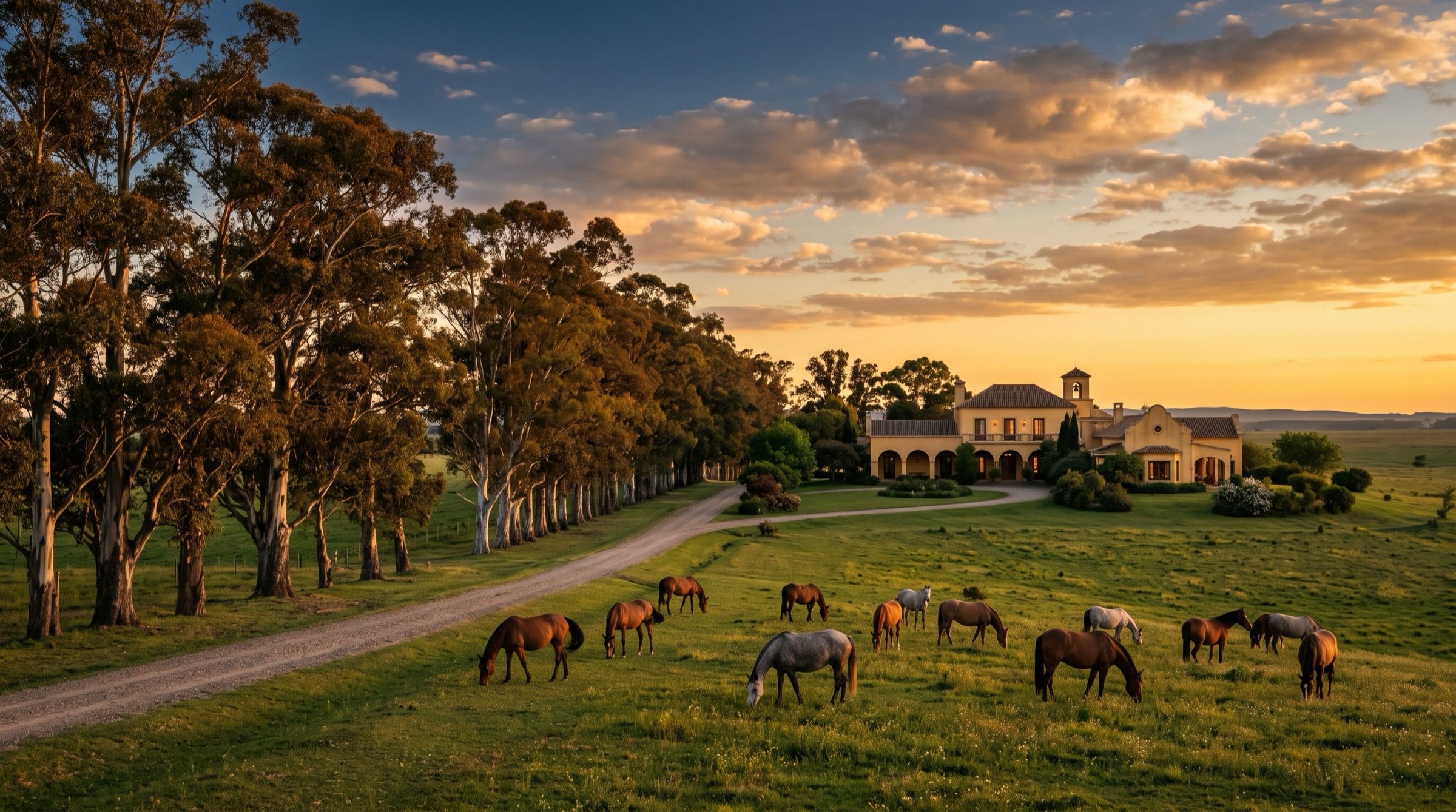
The estancia is one of Argentina’s great institutions: a working ranch with a main house, a long avenue of trees, horses, cattle or crops, and often a polo field. For a foreign family it can be a place to spend the summer, a store of value in hard assets, and a business that pays part of its own costs.
This guide covers the legal position after September 2026, the checks that matter on rural land, typical regions, and how owners run estates from abroad. It builds on our general guide to buying property in Argentina as a foreigner, which explains the notary-led purchase process.
The rural land law in October 2026
The rules on foreign ownership of rural land have changed several times since 2023.
- Ley 26.737 (2011), the Rural Lands Law, capped foreign ownership at 15% of rural land nationally and locally. It limited any one nationality to 30% of that share, capped any one foreign holder at 1,000 hectares in the core farming zone, and barred foreigners from land containing large bodies of water or in border security zones.
- DNU 70/2023, President Milei’s emergency decree of December 2023, repealed that law in Article 154.
- In March 2024, the Federal Appeals Court of La Plata declared Article 154 unconstitutional with collective effect, which restored the limits.
- On 29 September 2026, the Supreme Court revoked that ruling. It found that the plaintiffs, a Malvinas veterans’ centre, had no standing to bring a collective action. It expressly did not decide whether the repeal is constitutional.
As a result, the national caps do not currently apply. But the matter is not closed:
- Congress. The Senate voted to reject DNU 70/2023 in March 2024. A decree falls only if both chambers reject it. Opposition blocs have requested a special session of the Chamber of Deputies for 15 October 2026 with the decree on the agenda. As of 10 October, quorum was uncertain.
- New lawsuits. Because the Court ruled on standing, a different plaintiff could bring a new constitutional challenge.
- Legislation. In August 2026 the government withdrew a chapter on foreign land ownership from its property bill for lack of votes.
What this means in practice: a purchase today is lawful under the current rules, but contracts should allocate the risk of a change in the law. Ask your lawyer about conditions precedent, timing of payment and what happens if a cap is restored between signing and the deed.
Border security zones
Separately from the rural land law, foreigners need prior approval (previa conformidad) from the Ministry of the Interior’s frontier directorate to buy, lease or take possession of property inside a Zona de Seguridad de Fronteras. The rule covers urban and rural property. The application can be filed online or through the notary.
Border zones matter in every province that touches a frontier, from Mendoza, the Patagonian lake district and Salta to Misiones and Corrientes. The national geographic institute (IGN) publishes a map tool to check a plot. Allow for this approval in your timetable.
Water, rivers and forest
Rural due diligence starts with what the land can legally and physically support.
Water. Under Article 235 of the Civil and Commercial Code, rivers, streams, navigable lakes and lagoons, and glaciers belong to the public domain. Groundwater is also public, subject to the landowner’s right to extract it for their own needs. In irrigated provinces such as Mendoza, water rights attach to the land and decide its value; see our guide to Mendoza wine country.
Riverbanks. Article 1974 of the Code requires owners of land beside navigable waters to leave a 15-metre strip free along the bank (the camino de sirga). Bills to restore the older, wider strip have been introduced in Congress. Check how any river frontage is affected.
Native forest. Under Ley 26.331, each province maps its native forests into three categories: red (no clearing), yellow (sustainable use only) and green (clearing possible after an environmental impact assessment and public hearing). The government has proposed changes to this regime, but check the current rules. Ask for the forest category of every plot, and check for past illegal clearing, which can follow the land.
Typical regions
| Region | What you find | Points to check |
|---|---|---|
| Pampas (Buenos Aires, Santa Fe, south of Córdoba) | Crop and cattle land, classic estancia houses, polo | Flooding history, drainage, lease contracts |
| Entre Ríos and Corrientes | Cattle, forestry and wetlands | Border zones, rivers and water bodies |
| Mendoza, San Juan, Salta | Vineyards and irrigated estates | Water rights, hail and frost, border zones |
| Patagonia | Large sheep and cattle estates, lakes and rivers | Border zones, national parks, access |
| North-west | Highland and valley estates | Native forest category, roads, border zones |
For regional detail, see our guides to Salta and the north, Patagonia and investing in Argentine wine.
Prices and returns
The Rosario Board of Trade (BCR) tracks land in the core farming zone. For the maize sub-zone around Pergamino, Rojas and Colón, it reported an average of about US$17,900 per hectare in January–July 2026. That beat the nominal record of 2012 after five years of rises from a low of US$13,950 in 2021. In real terms, prices remain about 28.5% below the 2012 peak.
The same analysis put rents at an average of about 19 quintals of soybeans per hectare, or about US$570 per hectare in the 2025/26 season, a gross yield of about 3.2% on land value.
Outside the core zone, prices per hectare fall sharply with distance from ports, rainfall and soil quality. We could not find a reliable 2025–2026 index for grazing land or Patagonian estates. Commission an independent valuation.
Export duties shape farm income. In mid-2026 soybeans paid a 24% duty and maize about 8.5%. A schedule made official in June 2026 lowers the soybean rate gradually from January 2027 to 15% by December 2028. Future cuts could be faster or slower.
Running an estancia from abroad
Most foreign owners choose one of three models:
- Lease the land. A local producer farms it and pays rent, often indexed to grain prices. The owner keeps the house and some paddocks. This is the simplest model.
- Hire a manager. An administrator runs the farm for the owner’s account, with a budget and regular reports. Income is higher in good years, and so is risk.
- Partner with an operator. An agricultural company farms the land under a share or management agreement.
Whichever model you choose, ask for monthly accounts, an annual audit and independent checks on livestock numbers and yields. Staff on the estate are employees under Argentine labour law; take local advice on contracts.
Taxes and holding structures
Ongoing costs include provincial rural property tax, municipal fees and the national personal assets tax (bienes personales). For a non-resident, Argentine assets are taxed at 0.5% a year through a local representative. Taxes on a later sale depend on your residence and on how the land is held. The choice between personal ownership, an Argentine company or a trust affects tax, succession and the rural law; speak to a qualified adviser before you sign.
Estancias and citizenship
An estancia does not give residence or citizenship. The Argentina citizenship by investment programme, announced on 2 October 2026, offers a US$350,000 contribution or a US$800,000 bond and has no real estate route. Its legal basis, DNU 366/2025, was ruled against by the Cámara Nacional Electoral in June 2026 and is under appeal to the Supreme Court; see our legal status update and cost guide.
Sources
- Palabras del Derecho, Supreme Court ruling on the Rural Lands Law (29 Sep 2026): https://www.palabrasdelderecho.com.ar/articulo/7025/La-Corte-Suprema-revoco-el-fallo-que-habia-declarado-inconstitucional-el-DNU-que-derogo-la-Ley-de-Tierras
- Chequeado, the Rural Lands Law after the Supreme Court ruling (30 Sep 2026): https://chequeado.com/el-explicador/ley-de-tierras-que-puede-pasar-ahora-con-los-limites-a-la-propiedad-extranjera-tras-el-fallo-de-la-corte-suprema/
- Chequeado, the repeal of the Rural Lands Law explained: https://chequeado.com/el-explicador/que-se-sabe-sobre-la-derogacion-de-la-ley-de-tierras-por-parte-del-gobierno-de-javier-milei/
- Buenos Aires Times, Supreme Court and foreign land purchases (30 Sep 2026): https://www.batimes.com.ar/news/argentina/supreme-court-clears-way-for-milei-to-scrap-limits-on-foreign-land-purchases.phtml
- Todo Jujuy, opposition requests a Chamber session on DNU 70/2023 for 15 October 2026 (1 Oct 2026): https://www.todojujuy.com/diputados-la-oposicion-convoco-una-sesion-derogar-el-dnu-70-y-tratar-endeudamiento-y-discapacidad-n296845
- Perfil, quorum for the requested session: https://www.perfil.com/noticias/politica/diputados-la-oposicion-pidio-sesion-para-tratar-el-dnu-7023-discapacidad-y-endeudamiento-familiar.phtml
- Parlamentario, land chapter withdrawn from the property bill (5 Aug 2026): https://www.parlamentario.com/2026/08/05/se-cayo-la-reforma-de-la-ley-de-tierras-sin-los-votos-bullrich-y-aliados-acordaron-retirar-el-capitulo/
- Argentina.gob.ar, Previa Conformidad for border security zones: https://www.argentina.gob.ar/interior/asuntos-tecnicos-de-fronteras/solicitud-de-previa-conformidad
- IGN, border zone map tool: https://www.argentina.gob.ar/noticias/el-ign-publico-en-su-web-las-nuevas-zonas-de-seguridad-de-frontera-y-areas-de-desarrollo-de
- Civil and Commercial Code, Article 235: https://www.conceptosjuridicos.com/ar/articulos/codigo-civil-y-comercial-articulo-235/
- Chamber of Deputies, bill 4942-D-2024 on the camino de sirga (Article 1974): https://www4.hcdn.gob.ar/dependencias/dsecretaria/Periodo2024/PDF2024/TP2024/4942-D-2024.pdf
- Chequeado, native forest law and proposed changes: https://chequeado.com/el-explicador/el-gobierno-quiere-modificar-leyes-sobre-el-bosque-nativo-que-esta-pasando-con-el-desmonte-en-argentina/
- FAOLEX, Ley 26.331 text: https://faolex.fao.org/docs/pdf/arg124964.pdf
- Agrofy News, BCR land prices and rents (24 Aug 2026): https://news.agrofy.com.ar/noticia/216458/campos-volvieron-tener-precio-record-despues-15-anos-hay-dato-todavia-sorprende
- El Cronista, export duty schedule to 2028 (22 May 2026): https://www.cronista.com/economia-politica/las-retenciones-a-la-soja-bajaran-a-15-en-diciembre-de-2028/
- Análisis Digital, export duty cuts made official (3 Jun 2026): https://www.analisisdigital.com.ar/economia/2026/06/03/oficializaron-la-baja-de-las-retenciones-y-trazaron-un-esquema-de-disminucion-hasta-2028
- PwC Worldwide Tax Summaries, Argentina, other taxes (personal assets tax): https://taxsummaries.pwc.com/argentina/individual/other-taxes