Key facts
- Tigre is about 28 km north of Buenos Aires, with frequent trains from Retiro.
- The Paraná delta covers about 14,000 km² and was designated a Ramsar wetland in 2015.
- Tigre municipality includes about 221 km² of islands in the first section of the delta.
- The Buenos Aires Rowing Club dates from 1873 and the Yacht Club Argentino from 1883.
- Colonia del Sacramento, a UNESCO site since 1995, is about 1.5 hours from Buenos Aires by ferry.
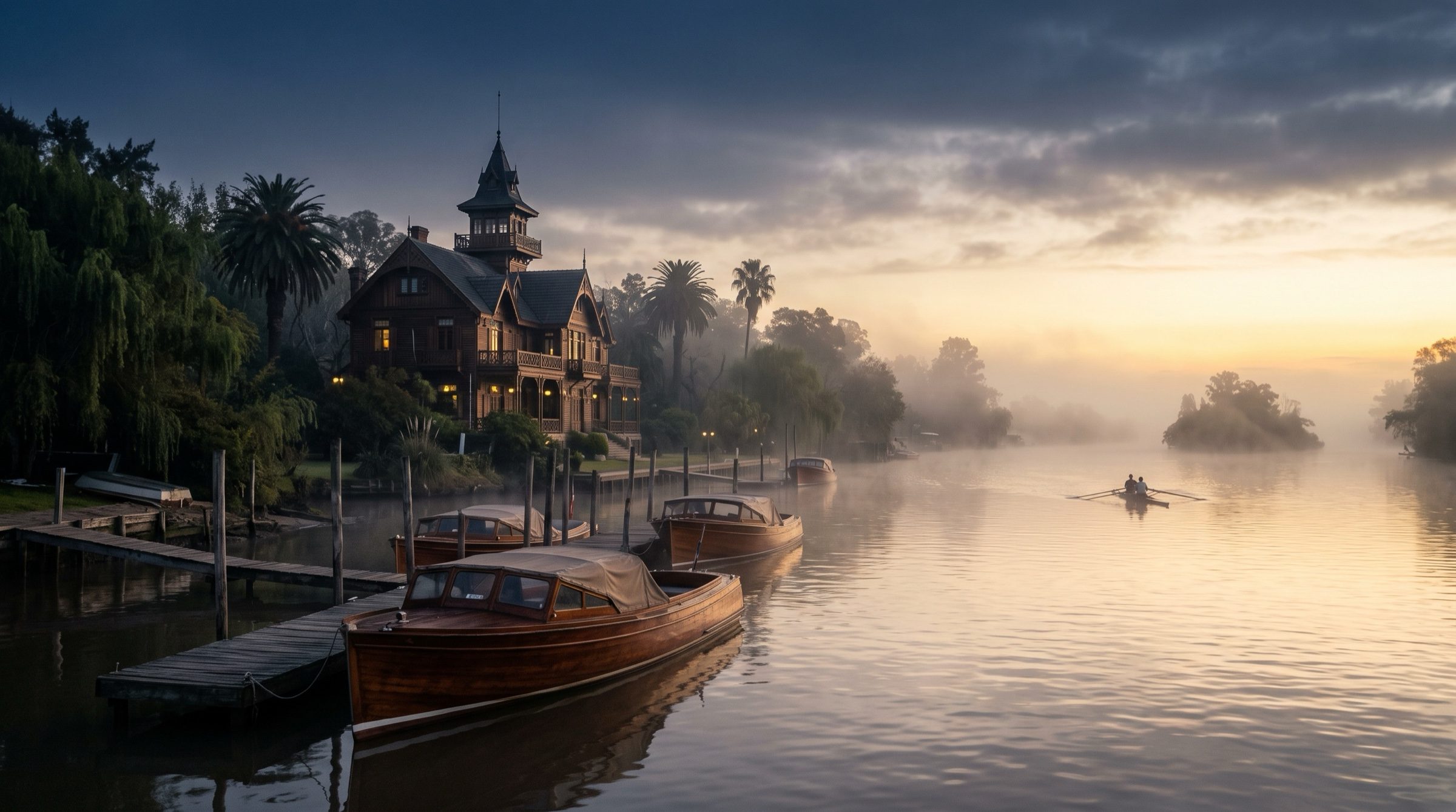
The delta begins where the city ends. North of Buenos Aires, the Paraná river breaks into hundreds of channels before it meets the River Plate. Houses stand on stilts above the water, launches act as buses, and rowing crews train past historic clubhouses. By the 1890s the Tigre Hotel was drawing Buenos Aires society, and the area remains one of the most distinctive places to own a weekend house in Latin America.
This guide explains the delta, its clubs, island life and the crossing to Uruguay.
The delta at a glance
The Paraná delta covers about 14,000 km² and runs some 320 km, mainly through Entre Ríos with parts in Buenos Aires province and Santa Fe. It was designated a Ramsar wetland of international importance on 3 October 2015.
Closest to the city is the first section of islands, which falls under Tigre municipality. Of Tigre’s 368 km², about 221 km² are islands. Further out, the second and third sections belong to San Fernando; part of them forms the Delta del Paraná Biosphere Reserve, declared by UNESCO in 2000.
The town of Tigre sits about 28 km north of central Buenos Aires. Mitre line trains run from Retiro every 10 to 30 minutes, and the Tren de la Costa connects through the riverside suburbs. Next to the station, the Puerto de Frutos, once a fruit market, is now a riverside crafts fair.
The clubs: rowing since the 1870s
Rowing gave Tigre its character. On 10 December 1873 the first official regatta in Argentina was held on the Luján river at Tigre, with President Domingo Faustino Sarmiento in attendance. A few days later, on 16 December 1873, mostly British rowers founded the Buenos Aires Rowing Club, today at Calle Mitre 226 in Tigre.
The grandest building is the former Tigre Club, begun in 1910 as a social club with a European-style casino. It was declared a national historic monument in 1979 and has housed the Museo de Arte Tigre, with a collection of Argentine art, since 2006.
Sarmiento himself kept a house in the delta, which he used to test the area’s economic potential.
Yacht clubs and sailing
Two clubs dominate sailing on the River Plate:
- Yacht Club Argentino (YCA), founded on 2 July 1883, is one of the oldest yacht clubs in the world. Its headquarters, opened in 1915, stands on a pier in Dársena Norte, Puerto Madero. It has a site in San Fernando (from 1932), one on Isla Zárate in the delta and two in Mar del Plata. It has organised the Buenos Aires–Río de Janeiro race since 1947 and helped found the body now called World Sailing.
- Club Náutico San Isidro (CNSI), founded on 26 February 1910, sits on the river at San Isidro and has hosted world championships in the Snipe, Optimist, 49er and Star classes.
Ask each club early how membership works, including sponsorship by existing members, entrance fees, waiting lists and mooring availability. The clubs are also a natural way into social life for newcomer families; see our guide to polo, tango and social life.
Island houses: what to know
The delta islands have permanent residents and many weekend houses. Life works differently from the mainland:
- Transport. There are no roads on most islands. Shared passenger launches (lanchas colectivas) serve the channels on timetables, alongside private boats and water taxis. Each morning, school launches leave Tigre to collect island children for about a hundred island schools.
- Building. Houses are built on stilts (palafitos) to stay above regular floods. The delta is naturally flood-prone, and water levels are strongly influenced by tides and wind.
- Fire. In dry years the delta’s wetlands can burn. Fires in 2008 affected at least 65,000 hectares.
- Services. Ask how the house gets drinking water, power and waste collection, and how quickly a boat can reach it in an emergency.
For a buyer, the questions are practical. Check flood history and the height of the floor above the highest recorded water, the state of the piles and the jetty, and whether the river frontage is affected by the 15-metre riverbank strip (camino de sirga) that the Civil and Commercial Code reserves along navigable waters. Ask the notary to confirm title carefully; island boundaries and riverbanks can change.
We could not find a reliable 2025–2026 source for island house prices. Ask several local agents. Our guide to buying property in Argentina as a foreigner explains the purchase process.
Crossing to Uruguay
Uruguay lies across the River Plate. Two destinations are favourites:
- Colonia del Sacramento, founded by the Portuguese in 1680, has a historic quarter listed by UNESCO in 1995 and a yacht pier. Ferries from Buenos Aires take about 1.5 hours.
- Carmelo, further up the river near the delta, is known for its wineries. Its port on the Arroyo de las Vacas receives small passenger catamarans from Tigre. Nearby, at Zagarzazú, the Four Seasons Carmelo hotel has a golf course.
Licences. The Prefectura Naval Argentina, the national maritime authority, issues recreational licences. The basic conductor náutico certificate covers boats up to 10 metres and 150 HP in inland waters and defined zones of the River Plate. Larger boats and wider waters need higher certificates, such as the yacht helmsman (timonel de yate) certificate. Check which licence your crossing requires.
Formalities. A crossing to Uruguay is an international voyage. The boat must be cleared out of Argentina and into Uruguay, and every passenger must pass migration on both sides. Procedures change, so ask your club and Prefectura for the current rules before your first trip.
For families who prefer to fly, Punta del Este is a short hop from San Fernando airport, next to Tigre; see our guide to private aviation in Argentina.
Tigre and citizenship
A house in the delta does not give residence or citizenship. Families who want an Argentine passport may consider the Argentina citizenship by investment programme announced on 2 October 2026. Its legal basis, DNU 366/2025, was ruled against by the Cámara Nacional Electoral in June 2026 and is under appeal to the Supreme Court; see our legal status update. For mainland homes near the river, see San Isidro and Nordelta in our guide to Buenos Aires neighbourhoods.
Sources
- Tigre, Buenos Aires (distance, trains, Puerto de Frutos, Tigre Club): https://en.wikipedia.org/wiki/Tigre,_Buenos_Aires
- Paraná Delta (area, Ramsar designation): https://en.wikipedia.org/wiki/Paraná_Delta
- Delta del Paraná (launches, palafitos, island schools, Biosphere Reserve, 2008 fires): https://es.wikipedia.org/wiki/Delta_del_Paraná
- EcuRed, Partido de Tigre (insular area): https://www.ecured.cu/Partido_de_Tigre
- Buenos Aires Rowing Club: https://es.wikipedia.org/wiki/Buenos_Aires_Rowing_Club
- Museo de Arte Tigre: https://es.wikipedia.org/wiki/Museo_de_Arte_Tigre
- Yacht Club Argentino: https://es.wikipedia.org/wiki/Yacht_Club_Argentino
- Club Náutico San Isidro: https://es.wikipedia.org/wiki/Club_Náutico_San_Isidro
- Colonia del Sacramento: https://en.wikipedia.org/wiki/Colonia_del_Sacramento
- Carmelo, Uruguay: https://en.wikipedia.org/wiki/Carmelo,_Uruguay
- Prefectura Naval Argentina: https://www.argentina.gob.ar/prefecturanaval
- Argentina.gob.ar, conductor náutico certificate: https://www.argentina.gob.ar/servicio/obtener-el-certificado-de-conductor-nautico
- Civil and Commercial Code, Article 235 (public domain waters): https://www.conceptosjuridicos.com/ar/articulos/codigo-civil-y-comercial-articulo-235/
- Chamber of Deputies, bill 4942-D-2024 on the camino de sirga (Article 1974): https://www4.hcdn.gob.ar/dependencias/dsecretaria/Periodo2024/PDF2024/TP2024/4942-D-2024.pdf