Key facts
- Argentina had 196,220 hectares of vineyards in 2025, according to the INV.
- Provisional 2025 wine exports: about 1.93 million hectolitres, worth US$661 million FOB.
- Domestic wine sales were about 7.5 million hectolitres, close to four times exports.
- Salta has about 3,600 hectares of vines, many above 1,650 metres.
- Rural land caps on foreign buyers are not in force after the September 2026 Supreme Court ruling, but the issue is political.
Many families first meet Argentine wine as visitors to Mendoza. Some then ask a harder question: should we own part of it? This guide looks at wine as an investment rather than a lifestyle. For the lifestyle side, where to live among the vines and how the seasons feel, see our guide to Mendoza wine country living.
It is general information, not investment advice.
The industry in numbers
The Instituto Nacional de Vitivinicultura (INV), the national wine authority, publishes the core data. For 2025 it reported:
| Indicator (2025) | Figure |
|---|---|
| Vineyard area | 196,220 ha |
| Number of vineyards | 20,939 |
| Grape harvest | 19.9 million quintals |
| Wine production | 10.77 million hl |
| Domestic wine sales | 7.46 million hl |
| Wine exports (provisional) | 1.93 million hl, US$661 million FOB |
| All exported wine-sector products (provisional) | US$891 million FOB |
Two things stand out. First, the domestic market is far larger than exports by volume, so most Argentine wine is sold in pesos. Second, the average export value works out at about US$3.40 a litre, so most exports are everyday wines. The premium end, where foreign buyers usually want to play, is a small part of the whole.
Mendoza produces roughly two-thirds of Argentina’s wine. Salta is small, at about 3,600 hectares on Wines of Argentina figures, but its altitude gives it a distinct identity.
Where foreign money goes
The Uco Valley
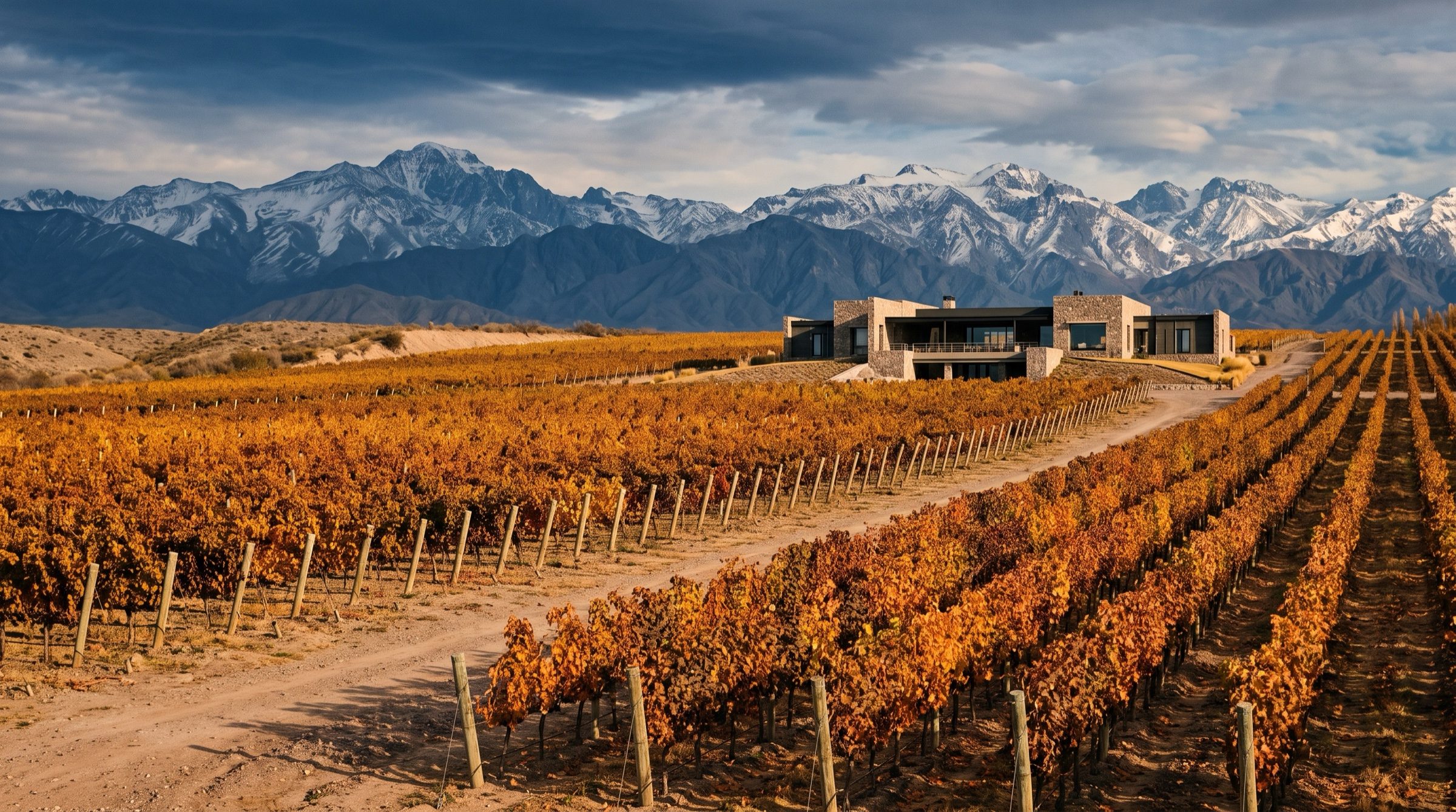
The Uco Valley, south of Mendoza city across Tupungato, Tunuyán and San Carlos, is the focus of most foreign investment at the premium end. Vineyards sit at about 1,200 metres and above, close to the Andes. International winemakers such as Michel Rolland and Paul Hobbs have worked in high-altitude Mendoza, and the region is linked to Argentina’s most highly rated Malbecs.
Salta and the Calchaquí valleys
In Salta, Cafayate holds most of the province’s vines at about 1,650 to 2,000 metres, and some vineyards reach above 3,000 metres. Bodega Colomé, owned by the Hess family since 2001, cites its highest vineyard at 3,111 metres. Distance is the trade-off: Cafayate is about 189 km from Salta city by mountain road, which raises the cost of supplies, labour and visits. See our guide to Salta and the north.
Four ways to own a piece
| Model | What you own | Your involvement | Main risk |
|---|---|---|---|
| Managed vineyard estate | A private plot, often with a house site | Low; the developer farms and makes wine for a fee | Developer quality, fees, resale market |
| Bare land to plant | Land and water rights | High; you plant and wait several years for a first crop | Cost overruns, delay, water |
| Operating vineyard selling grapes | A going concern | Medium; a manager runs it | Grape prices, weather, labour costs |
| Stake in a winery | Shares in a company | Low to medium | Governance, minority rights, exit |
Managed vineyard estates. Several developments in the Uco Valley sell private vineyard plots, with the developer’s team farming the vines and helping owners make wine under their own label. Our Mendoza guide describes one example. These suit families who want their own wine and a house without running a farm. Read the management contract closely: annual fees, who decides on farming, how much wine you receive, and what happens if the developer is sold.
Bare land. Buying land and planting gives the most control and the most risk. A new vineyard takes several years to produce a full crop, and costs arrive before income. You need water rights, an agronomist, frost and hail protection and a plan for selling grapes or making wine.
Operating vineyards. A vineyard that sells grapes to wineries produces income from the first year. Returns depend on grape prices, which follow the domestic market.
Winery stakes. A minority stake in a winery is an equity investment in a private company. Ask for audited accounts, a shareholders’ agreement with clear exit rights and tag-along protection, and a view on how the brand performs abroad.
The risks
- Weather. Mendoza is a desert under the Andes. Hail and late frost can destroy a crop. Hail netting and frost protection reduce the risk but add cost.
- Water. Vineyards depend on meltwater rivers, irrigation channels and boreholes. Water rights attach to the land and largely decide its value. Check them first.
- Costs in pesos, income in dollars. Exporters earn in dollars but pay most costs in pesos. When local costs rise faster than the exchange rate, margins shrink.
- A domestic market. Most volume is sold inside Argentina, where consumer incomes drive demand.
- Law and politics. The national caps on foreign ownership of rural land were repealed by DNU 70/2023. On 29 September 2026 the Supreme Court revoked a lower-court ruling that had restored them, on standing grounds, without ruling on the decree’s constitutionality. The opposition has requested a Chamber of Deputies session on 15 October 2026 to reject the decree. Build protection into any contract.
- Border zones. Vineyards in the Uco Valley and in Salta can lie in border areas. Foreigners need prior approval (previa conformidad) from the Ministry of the Interior to buy inside a border security zone.
- Liquidity. Vineyards and small wineries can take a long time to sell, and buyers are few.
We could not find reliable public data on the returns of vineyards or wineries in Argentina, nor a reliable 2025–2026 source for vineyard land prices per hectare. Prices vary with altitude, water, access and vine age. Ask several local agents and an independent agronomist.
Due diligence checklist
- Confirm title, boundaries and water rights with a notary and the provincial water authority.
- Commission an agronomist’s report on vine age, varieties, health and yields.
- Check border zone status with the national geographic institute’s map tool.
- Review management, supply and offtake contracts.
- Model costs in pesos and revenue in dollars under several exchange-rate scenarios.
- Take tax advice on the holding structure: personal ownership, an Argentine company or a trust. Non-residents pay the personal assets tax on Argentine assets at 0.5% a year.
Our guides to buying property in Argentina as a foreigner and buying an estancia cover the purchase process and rural law in more depth.
Wine and citizenship
A vineyard does not give residence or citizenship, and the Argentina citizenship by investment programme has no real estate or business route: it offers a US$350,000 contribution or a US$800,000 bond. Its legal basis, DNU 366/2025, was ruled against by the Cámara Nacional Electoral in June 2026 and is under appeal to the Supreme Court; see our legal status update. For the wider economic picture, see Argentina’s economy under Milei.
Sources
- INV, main wine-sector data for 2025: https://www.argentina.gob.ar/inv/estadisticas-vitivinicolas/principales-datos-vitivinicolas
- INV, export market statistics: https://www.argentina.gob.ar/inv/estadisticas-vitivinicolas/mercado-externo
- Decanter / Wines of Argentina, Salta vineyard area: https://www.decanter.com/sponsored/salta-winemakings-high-point-549433/
- Decanter, Bodega Colomé: https://decanter.com/wine-reviews/argentina/salta/bodega-colome-torrontes-salta-argentina-2016-13797
- South America Wine Guide, Calchaquí valleys: https://southamericawineguide.com/ultimate-guide-to-the-calchaqui-valleys-wine-region/
- Argentine wine (regions, Uco Valley, foreign winemakers): https://en.wikipedia.org/wiki/Argentine_wine
- Mendoza wine (production share, irrigation): https://en.wikipedia.org/wiki/Mendoza_wine
- Cafayate (distance and altitude): https://en.wikipedia.org/wiki/Cafayate
- Palabras del Derecho, Supreme Court ruling on the Rural Lands Law (29 Sep 2026): https://www.palabrasdelderecho.com.ar/articulo/7025/La-Corte-Suprema-revoco-el-fallo-que-habia-declarado-inconstitucional-el-DNU-que-derogo-la-Ley-de-Tierras
- Todo Jujuy, opposition requests a session on DNU 70/2023 (1 Oct 2026): https://www.todojujuy.com/diputados-la-oposicion-convoco-una-sesion-derogar-el-dnu-70-y-tratar-endeudamiento-y-discapacidad-n296845
- Argentina.gob.ar, Previa Conformidad for border security zones: https://www.argentina.gob.ar/interior/asuntos-tecnicos-de-fronteras/solicitud-de-previa-conformidad
- PwC Worldwide Tax Summaries, Argentina, other taxes: https://taxsummaries.pwc.com/argentina/individual/other-taxes